I've been using my holiday time to think about work (hmmmm) and I've decided how I can combine my main hobby with my job.
You won't be surprised to hear it means the launch of yet another web based platform but I'm pretty sure that as the content gets added, it will be worth a visit on more than one occasion.
I have decided to dedicate some time to recording and presenting a series of photographs based around the concept of social documentaries. This means that I will be recording photosets centred around people, places and events.
The website is already online and I'd be very grateful if you would consider adding it to your bookmarks and checking it out every now and again.
A week ago I was able to spend some time in Shropshire.
I was visiting Emma's Auntie and Uncle who live half way up a hill in some of the most beautiful countryside I have seen in the UK.
I have posted one of my photos which I took and even as I look at it again now, I am remembering what a fantastic time I had and what a wonderful place it is to visit.
I'd just like to thank Sue and Richard for their hospitality and hopefully I'll see you both again sometime. To anyone else reading this, if you get the chance to spend some time in this wonderful county, don't pass the chance up!
I've been busy searching through some of my favourite photographs from the past three and a half years and here's the result.
www.paulhurstphotography.com features some of my most popular work along with some of my personal favourites. Let me know what you think, and if you have your own photoblog or photowebsite then why not post a link here for other visitors to check out too.
This video, which demonstrates Microsoft's new technology called 'Photosynth' shows that with a bit of lateral thinking, some amazing things are still possible with computers. Things that haven't been thought of before.
The video shows how sites like flickr, which host millions of pictures online, can be used to join millions of photos from millions of photographers together to create a 'seamless' 3D photo, where users can navigate around a space and examine the scene in minute detail.
The principal works on the basis that millions of pictures may be taken of one object, some on purpose, but also some by chance. These pictures can be analysed and then 'mapped' together to create a navigable environment. This is because each photo may capture the same building or scene but from a slightly different angle. By overlapping these pictures and by skewing or distorting them to include distance information, it's possible to create a navigable virtual world which is overlayed with real-world photographs. Even though The pictures may have been taken on all kinds of different cameras and for all kinds of different reasons.
The technology is new and slightly 'gimmicky' at the moment but in the future, it could offer invaluable evidence at crime scene locations where members of the public have recorded material on their mobiles which when joined together spatially, could offer a new insight into events as they actually occurred. The basis being that although one picture may lie, tens, hundreds or even thousands will not. If only this technology had been around in 1963 with the Kennedy Assassination?
The technology video is included in its entirety below although the 'Photosyth' section starts from about 2-3 mins in.
***Click the title to go to http://paulhurst.vox.xom***
As past of a blogging experiment into both methods and equipment used for the modern day bloggers, I have just started a new moblog.
rather than another place to write about things, this new blog concentrates on the world through the lens of my mobile phone. There's little to read but lots of pictures and videos to watch instead.
I suppose its a reflection on blogging technology and practice itself. As it stands, there are blogs out there that read like a personal journal and other that read more like a newspaper column and they are both largely centred around text. This is because visual media generally requires more effort to produce and upload.
As in my last post though, thats all about to change. the new handsets from Nokia at least, allow blogging integration straight from the camera app which means with an extra button press, your content is uploaded to your blog or flickr account. Couple this with more flexible data tariffs on mobiles and an ever widening internet 'hotspot' in our towns and cities and the result is a much more integrated lifestyle between people and their online blogs or second lifes, or whatever.
Its this kind of thing which has driven me to experiment. I wonder how my life will change if I am able to maintain a moblog without carrying a laptop round to coffee shops. I wonder what impact this record will have on my own understanding of who I am and what I do and even how I interpret events and emotions around me.
If a picture is worth a thousand words, how many must a constantly developing and evolving online journal be worth? I'm about to find out.
I have recently been working and devising a photojournalism course for use within secondary schools and as the project draws to a close, I thought I'd blog about it a bit for any teachers who want to explore ways of looking at photography/art/media and communication outside of the classroom.
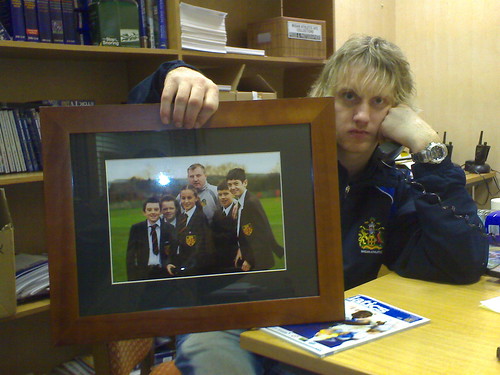
Pictured above is Tony Smith from Wigan Athletic who manages the community bus which allows the club to deliver ICT and media training in schools. Some of you may know that since the start of this academic year, I have been working as part of this team and I decided that this would be the ideal platform to build further on my ideas of how to use photography to engage people in community related issues.
For this project, we took a group of five students to the training ground where they had chance to have a go at sports photography as Wigan Athletic were training. The coaching staff and team were excellent and the Manager kindly allowed me to take an 'official photo' which will now be signed and presented to the school.
After the photoshoot, Tony showed the students round the JJB stadium and then held a mini press conference in the press room, all the time, reinforcing how the media work with the club on matchdays to get all the important info into the public domain as quickly as possible.
The project has proved to be incredibly successful and for me, it goes to show that within education, media can be used as a useful tool to engage pupils with curriculum topics and in this case, take a more detailed look at the world around them.
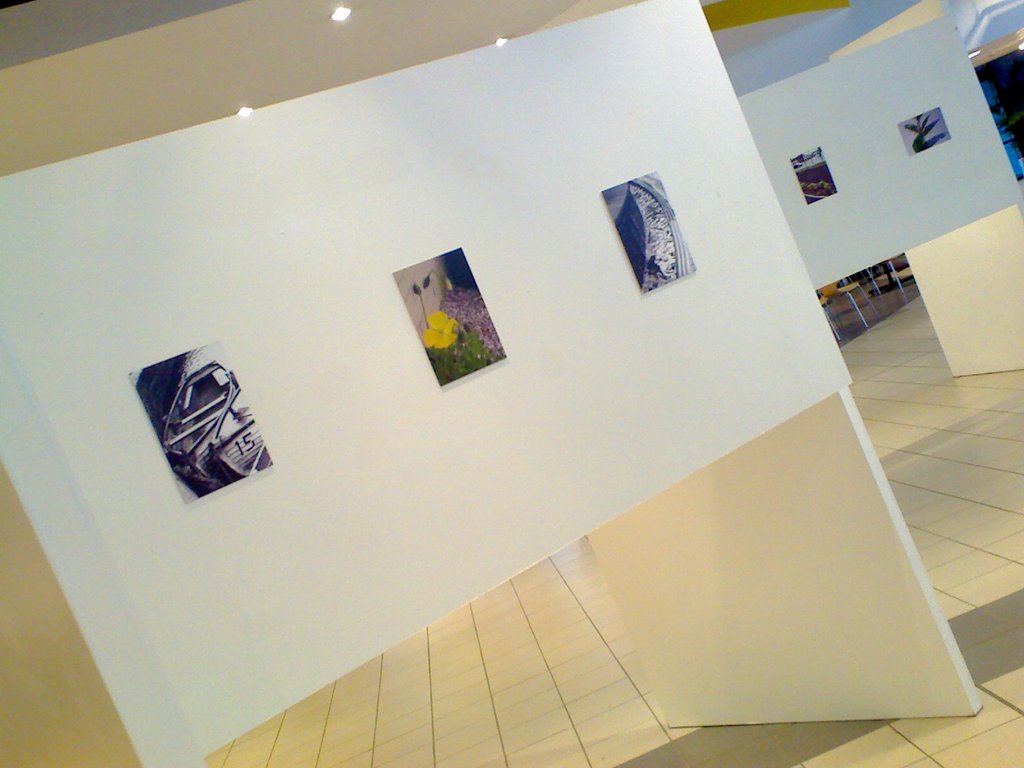
Sunday was a busy day for me as I put the finishing touches to a special exhibition of photography which opens at the Wythenshawe Forum later on Monday.
The work will be on display for two weeks and the photographs have all been taken by my students who studied on a course which I developed (pardon the pun!) and delivered for Manchester city council.
The work started a number of months ago when another BBC freelancer and friend contacted me to ask if we could write a short course to introduce people to digital photography, so we got together and devised a four week course which was aimed at complete beginners, to show them the ropes and get to grips with some of the current crop of digital compacts.
I then tutored around sixty people from four different community centres around Manchester and we looked at the basics along with some of the more advanced techniques of how to get the best out of even the point-and-click digitals.
I suppose its a common mistake, but lots of people often think that you need to spend mega £££ to get equipment thats good enough to take an award winning photograph, and while it can help, I think most people found it refreshing to find out that its not a necessity. All thats really needed is a 'good eye' and a bit of luck by being in the right place at the right time.
Some of the group were just intrigued by what they could achieve with their new piece of kit whilst others wanted to incorporate photography with their own art-related hobbies and one lady (Janet) was learning how to take better pictures for her blog.
Whatever the reason for being on the course, I feel that digital photography has something to offer most people who give it a go and even as Damian and myself devised the course, I began to plan for a special exhibition which would be used to showcase some of the photos taken by those on the course. Its this exhibition which finally saw the light of day today and as we stood back from the pictures which had just been hung, I felt very proud of each and every photographer represented there.
It would be easy to finish my post be saying that the course went well and that I'd like to do another but I'm hoping we've achieved more than that. I'm hoping that we've inspired some people to take a closer look at the world around them and I hope that we've helped others to realise that they have the skills to learn and grow in areas that they never thought possible.
Sometimes, we may think that as we press the button down, we are showing people whats going on in the world outside of the camera lens, but quite often we are also allowing people a glimpse inside our minds and sometimes even our hearts too.
The photographs may be seen for two weeks at the Wythenshawe Forum, Manchester.
I work as a freelance journalist and producer in Manchester. I also work in local schools helping young people have a go at making their own radio programmes.
In my spare time, I enjoy getting out and about and meeting new people